

Apartment hunting hasn't changed since listings moved online. Kaleno is building an AI renter's agent that turns plain-language requests into targeted shortlists and automated property follow-ups - moving rental search from endless scrolling to seamless action.
Zero-scroll search is a new way to find a home. You describe what you want once, in your own words, and an AI agent does the searching, comparing and follow-up, then brings back a short list worth your time. Kaleno is an AI apartment search agent at kaleno.com, built for zero-scroll search. We call it the renter's agent because it does that work on your behalf.
Apartment hunting has looked about the same since listings moved online. You set your filters and start scrolling. A dozen tabs turn into a spreadsheet, the spreadsheet turns into a group chat, and somewhere in there you message a few properties and wait to hear back. Listing sites made rental inventory searchable, which was a real leap for renters. The scrolling was the cost of that leap and renters pay it in hours: according to Zillow's Consumer Housing Trends Report, the average U.S. renter spends 10.4 weeks searching for an apartment before signing a lease. That's more than two months of continuous searching, comparing, and chasing responses. The traditional search process isn't just inefficient, it overwhelms renters with choices while leaving them to do all the heavy lifting.
Then the search itself started to change. Marketers named the first wave zero-click: people asked a question and the answer came to them, no website visit required. That was a shift in how people get information. Renting asks for more than information. It's a job with steps: work out what you need, find what fits, ask what the listing doesn't say, compare, decide and book, usually with someone else weighing in. A great answer handles the first step and leaves the rest with the renter.
We think renting goes zero-scroll next, and we're giving the shift a name so the people building it, covering it and investing in it have a shared word for it. Here's what it means and how we're building it.
What Is Zero-Scroll Search?
Kaleno uses "zero-scroll search" to describe an apartment-search experience in which an AI agent interprets a renter's needs, finds and compares homes, explains its recommendations, and handles property questions and follow-up. You say what you want in plain language, one time:
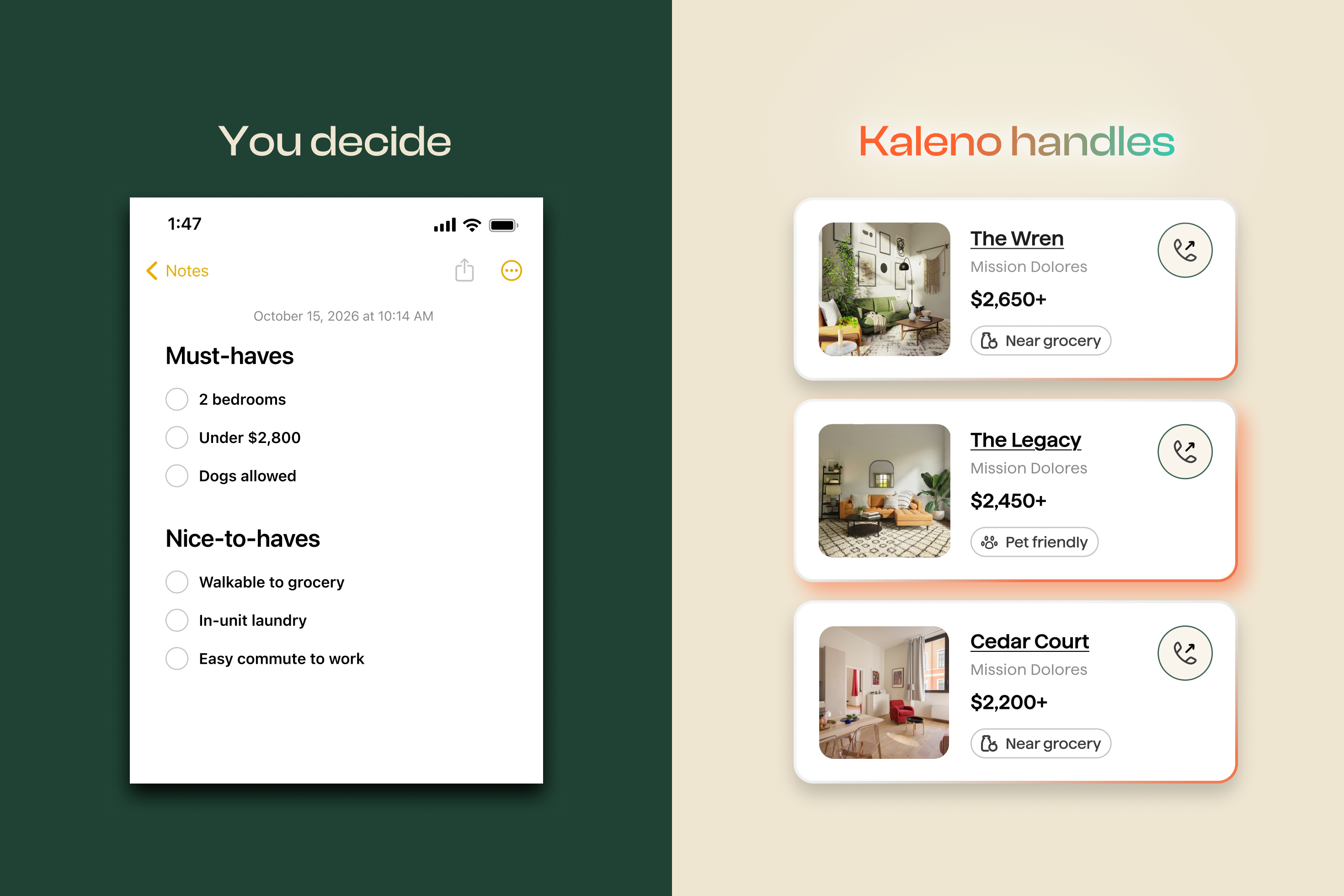
The agent turns that into a search, works through what's available, goes back to properties with your questions and returns a shortlist with its reasoning attached. Three things make a search zero-scroll:
Describe what you want. The agent turns one plain-language request into requirements and preferences, without making you rebuild filters.
Delegate the follow-up. The agent asks properties your questions, follows up and tracks replies.
Receive a reasoned shortlist. The agent returns selected homes with explanations tied to your needs.
The renter's agent is the role that makes this possible: an AI that works for the renter through the whole search, so the work keeps going after the results page. Kaleno is the renter's agent.
Why Does Apartment Search Need an Agent?
General AI assistants have gotten very good at answers, and renters already use them to research neighborhoods, prices and what to ask on a tour. Finding a specific home asks for something different. Availability changes daily. Every renter is trading what they need against what they'd like. The questions that decide a lease, like parking and move-in dates, are often ones only the leasing team can answer. And a search runs for weeks, so something has to remember all of it.
That's work, and work is what agents are for. A vertical agent can pick up where a general assistant leaves off because it's built around one job and the data that job needs. A general assistant can tell you what a two-bedroom near downtown usually costs. Kaleno's job is to find the one that's available, ask about the parking and let you know when the property writes back.
How Did We Build an Agent That Searches for Renters?
We built Kaleno around three jobs every renter does: working out what they need, weighing homes against the places their life runs between, and chasing the answers a listing doesn't give. Each one became a stage of the system.
1. Understand the Renter's Requirements and Preferences
Kaleno turns a renter's request into hard constraints, like budget, bedrooms, pets and move-in date, and softer preferences, like natural light, a quiet street or "not a giant complex." A dealbreaker filters. A preference ranks. Mix those up and you get four hundred results or none. This is the hardest part and where most of our effort goes. Renters talk in sentences and search systems run on filters. A good stress test is "somewhere my partner will stop complaining about the commute." That's a real requirement and no filter has ever existed for it.
2. Evaluate Homes Against the Places That Matter
Kaleno lets you name up to three places that matter, how you get to each one and how long you're willing to travel, then weighs every home against all three at once. Location in rental search usually means a pin on a map. People don't live at a pin. They live between places. Kaleno also reads listing details and property data and writes a short summary of each home, so your shortlist explains itself.
3. Contact Properties and Keep Track of Replies
Listings leave questions open. Is parking included? Can I move in on the 15th? Kaleno drafts those questions, sends them to the property on your behalf, brings the answers back into your search and keeps everything in one place. Leasing teams get a clear, specific question from a renter who already fits the home, which makes their job easier too.
Underneath, it's one engine with several agents on top: one summarizes, one talks with you, one writes to properties, and they all share the same picture of what you're looking for.
How Can You Tell If a Search Is Zero-Scroll?
Every search product says it has AI now. These are the three questions we use to decide whether a search is zero-scroll:
1. Can you describe what you want once, in your own words? 2. Does it do anything for you after showing results? 3. Do you end up with a short list and reasons, or with more to scroll?
What's Next for Zero-Scroll Search?
Understanding what someone means, weighing homes against their life and following through with properties are parts of the same job. Building Kaleno means connecting them, so an agent can carry a request through to a shortlist the renter understands and can act on. That's the shift we mean by zero-scroll search, and the idea we're building around.
Renters have always known what they wanted. Scrolling endless listings was never the point.
FAQ
What is zero-scroll search?
Kaleno defines zero-scroll search as an apartment-search experience in which an AI agent interprets a renter's needs, finds and compares homes, explains its recommendations, and handles property questions and follow-up. The renter refines the search and decides which homes to pursue.
How does zero-scroll search differ from zero-click search?
Zero-click describes searches that end with an answer and no website visit. Zero-scroll describes searches where an agent does the work of finding, comparing and following up. Zero-click is about where the answer shows up. Zero-scroll is about who does the work.
What is the renter's agent?
The renter's agent is an AI that works on a renter's behalf through the apartment search, from understanding what they need to asking properties questions and keeping track of the answers. Kaleno is the renter's agent.
How does Kaleno search and follow up for renters?
Kaleno turns your request into requirements and preferences, evaluates available homes against the places you named and returns a shortlist with the reasons behind each home. It also sends your questions to properties, follows up and brings the replies back into your search.
Can zero-scroll search work for partners or roommates?
Yes. Together Mode, launching in October 2026, lets partners or roommates share one search and one shortlist.