How Kaleno’s Return Session Intelligence (RSI) turns everything that changed while a renter was away into one short catch-up, and the decisions behind it.
How can an agent remember user preferences across separate conversations?
An agent remembers user preferences across separate conversations by storing them as structured state, such as stated preferences, saved favorites, listings already seen, and open threads with properties, then comparing that state against what changed while the user was away. Remembering is the foundation. The harder problem is deciding what deserves the user’s attention on return, which is what Kaleno’s Return Session Intelligence (RSI) is built to do.
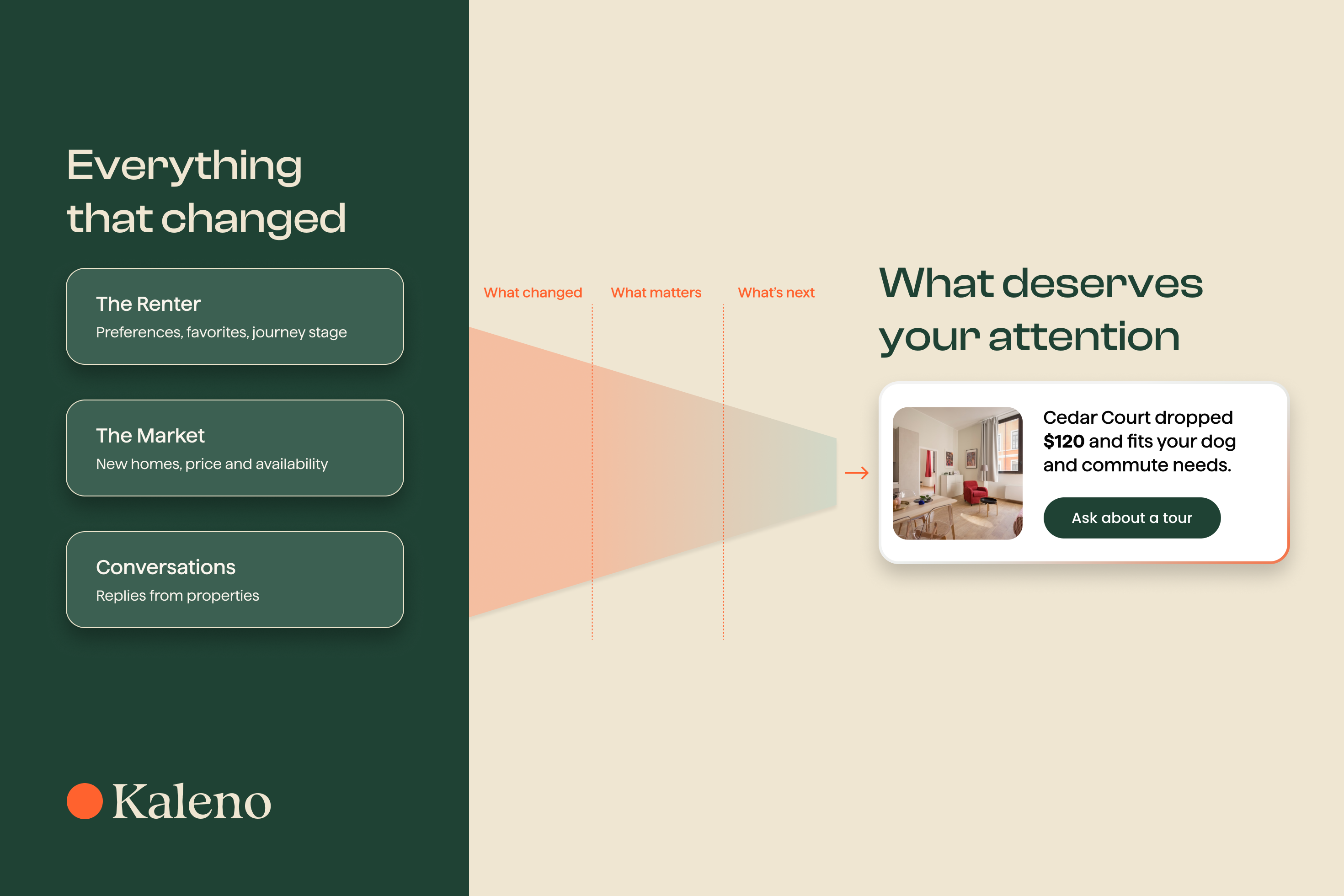
When a user returns after hours or days, presenting a static transcript frozen in time creates severe cognitive friction. Return Session Intelligence (RSI) is Kaleno’s architectural framework designed to solve this multi-session state decay. Rather than dumping raw log changes or locking the user into historical chat logs, RSI computes a high-signal state delta, curates what truly deserves user attention, and synthesizes an immediate, actionable "While you were away" briefing.
This technical deep dive explores the system design, algorithmic decisions, latency optimizations, and product tradeoffs behind RSI.
The Anatomy of Session Decay in Search Engines
Traditional search and recommendation platforms suffer from a systemic design flaw: session isolation. Renters evaluate homes across days, weeks, and months. Every time they return, traditional ILS platforms present a static home screen forcing the user to manually reconstruct their state, scan previous listings, and cross-reference multiple communication channels.
Before implementing RSI, Kaleno's chat suffered from four distinct failure modes:
The Dead Restart: High cognitive load required for the renter to reconstruct where their search left off and why specific properties were prioritized.
Invisible Asynchronous Progress: Critical market updates such as price drops on favorited properties, new high-confidence matches, or landlord replies, remained buried across fragmented product screens.
Suboptimal Engagement Windows: The first 10 seconds of a return visit represent the highest-intent window. Without structured guidance, users default to passive, unguided browsing.
Cross-Channel Disconnect: Asynchronous notifications sent via email or SMS were entirely disconnected from the primary conversational interface upon re-entry.
Research & Product Principles
Our technical design was grounded in key empirical insights derived from user research and agentic UX benchmarking:
In-Context Re-engagement over Navigation Overhead: Renters strongly prefer catching up within their primary conversational workflow rather than being redirected to external dashboards or notification feeds.
Catching Up to Move Forward: The primary objective of session recovery is not simply replaying history, but providing structured context to enable immediate forward momentum ("Catch up so you can pick back up in the right direction").
Transparent Attribution & System Integrity: Trust in AI assistants degrades rapidly if updates appear hallucinated or unexplained. Clear lineage mapping like indicating why a specific property or update is being highlighted is essential for long-term renter retention.
Key Architectural Decisions of RSI M1
RSI operates as an intelligent attention pipeline positioned between raw market data streams and the front-end conversational interface. The system logic resolves around four core engineering questions.
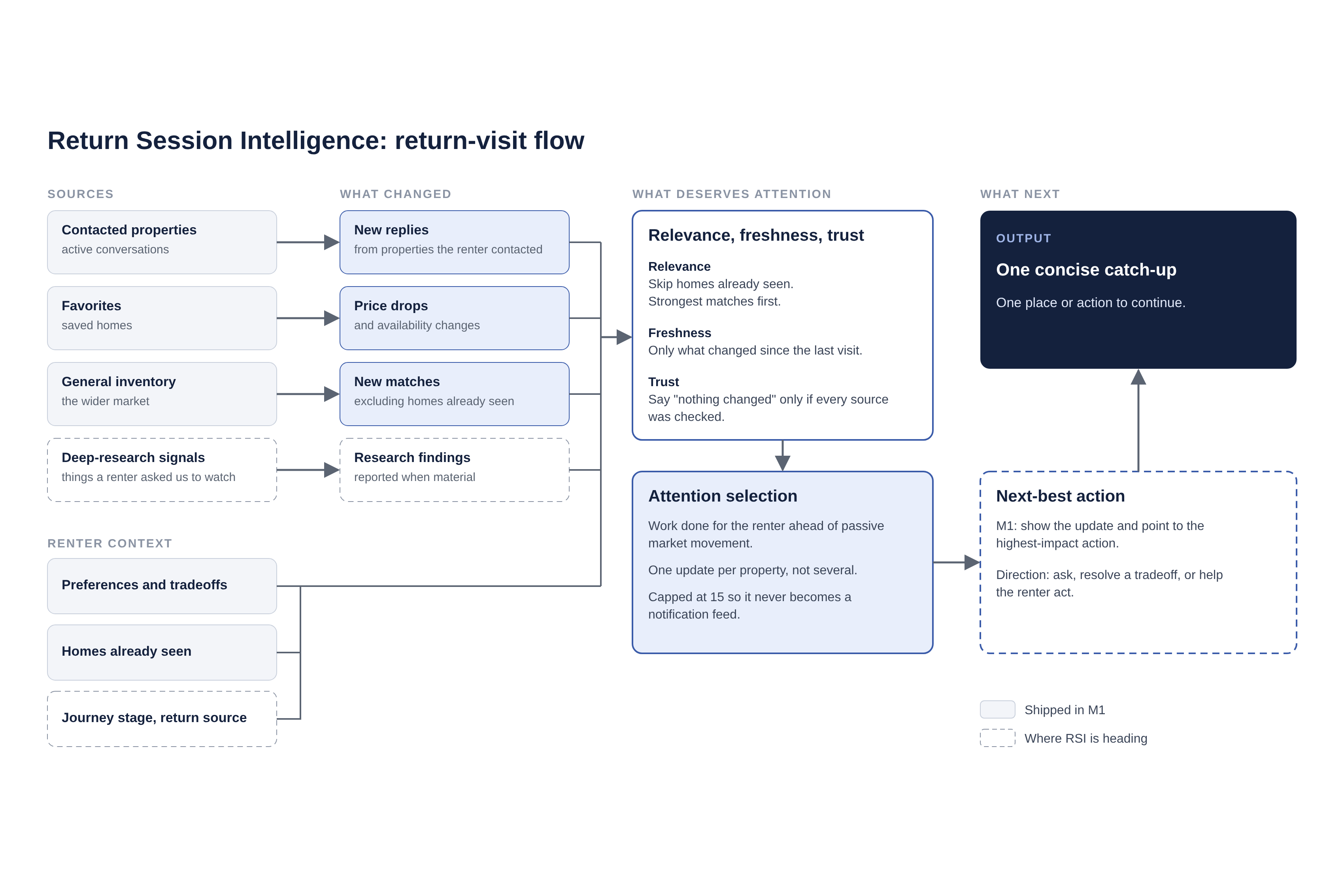
Candidate Change Extraction (The Delta Engine)
RSI computes state changes strictly relative to what the specific user has already seen, rather than global system timestamps. RSI tracks four high-value update categories:
Property Partner Replies: Direct outbound responses from landlords or property managers.
New Qualified Matches: Fresh inventory matching explicit and inferred user parameters (excluding already viewed listings).
Price Reductions: Price adjustments on saved or high-engagement properties.
Availability Shift: Status updates on saved inventory.
Attention Selection & Trust Mechanics
Surfacing every system change creates noise and fatigue. RSI narrows candidates through structured filtering rules:
Priority Weighting: Direct updates (replies) take precedence over passive events (price shifts). Priority is modeled as: priority = relevance to this renter × magnitude/significance of change × actionability × confidence/freshness. Factors such as the size of a price drop, the specific value of a reply, and the renter's level of interest in a property dynamically adjust this priority ranking.
Strict Ranking & Bounding: New matches are ordered by affinity score, with exact matches placed first and the candidate payload hard-capped at 15 properties to maintain cognitive focus.
Deterministic Empty-State Handling: If no material changes occur, the agent explicitly informs the user. Fabricating urgency degrades user trust.
Graceful Degradation Under Partial Failure: Data pipelines degrade independently. If a subsystem fails to return state, RSI renders available UI components but explicitly suppresses any assertion that "nothing changed".
Orchestration, Latency Budgets & Asynchronous Execution
A primary engineering challenge in conversational interfaces is end-to-end latency. Synthesizing complex multi-source summaries on-the-fly via LLMs can introduce 5-10 second latencies, breaking user flow.
To deliver immediate sub-second rendering, RSI implements a hybrid architecture:
Deterministic Rule-Based Prioritization: Ranking and selection logic are computed deterministically, sharing core business rules with off-site messaging services.
Asynchronous Narrative Pre-Generation: LLM summary synthesis is executed out-of-band and pre-generated for deterministic outcome combinations.
Parallel Pipeline Execution: Heavy retrieval operations execute in parallel asynchronously, ensuring slow inventory queries never block the primary conversational shell.
Boundary Gating: Defining the Return Session
Before running state evaluations, the engine executes a deterministic session gate:
Trigger Condition: A return visit occurs on a new calendar day with a minimum boundary threshold of 4 hours away.
Identity Continuity: Operates seamlessly across anonymous and authenticated states. Anonymous users are mapped via secure browser state tokens, ensuring stateful continuity prior to account creation.
Scope Discipline: Pragmatic Engineering Tradeoffs
Building production-grade AI requires disciplined scope control. For M1, we intentionally made three tactical trade-offs:
Scannable UI Components over Pure Text: M1 surfaces structured, scannable UI cards ending with a brief, high-impact conversational prompt, avoiding monolithic text blocks.
Uniform Heuristics over Complex Dynamic Personalization: M1 applies consistent priority scoring across the user base while collecting foundational telemetry to inform future individualized weighting models.
Leveraging Existing Data Schemas: Deferred features requiring novel data modeling or complex state storage to maintain high execution velocity.
Strategic Roadmap: The Evolution of RSI
As we iterate beyond M1, our AI research roadmap focuses on shifting from static state reporting to proactive agentic execution:
Contextual Deep Personalization: Tailoring summary density and tone based on user journey stage, implicit behavioral signals, and explicit search priorities.
Proactive Background Research: If a renter indicates preferences that listing data cannot answer—such as street vibe, specific commute nuances, noise level, or dog friendliness—the agent continuously researches external sources while they are offline. This includes asking questions in community forums or other channels on the renter's behalf when data is not yet available, surfacing findings once key significance thresholds are met.
Dynamic Action Execution: Evolving from passive update delivery ("Here is what changed") to goal-oriented action prompts ("Here is what changed, why it impacts your goal, and the recommended decision path").
Guidance for Building State-Aware Agents: Our Playbook
For AI leaders and systems architects building conversational return experiences, these are the questions we found most useful and the ones we forced ourselves to find a crisp answer to:
What actually deserves the user’s attention?
Not every change is worth surfacing. The harder problem is ranking updates by how relevant, significant and actionable they are for this specific user. A small price drop on a property they barely engaged with may matter less than a property reply answering a question they explicitly cared about.
How do you balance freshness, intelligence and latency?
The ideal briefing would use the freshest possible data, reason across everything you know about the user and do deeper research when needed — instantly. In practice, those goals compete. We’ve found it useful to be explicit about what must happen in the critical path, what can be deterministic, what can run in parallel and what can happen ahead of time or in the background.
How do you distinguish “nothing changed” from “we don’t know”?
In a system pulling from multiple sources, partial failures are inevitable. If one source fails, that should not prevent useful information from surfacing — but it should prevent the system from confidently claiming nothing changed. That distinction matters a lot for trust.
Once you have the user’s attention, what is the most useful next step?
A return experience should not become a smarter notification center. The goal is to help the user make progress: review something important, resolve a tradeoff, answer a useful question or take an action. For us, this connects back to a broader question: given what we know about the renter and the market right now, what is the highest-value thing the agent can do next?
Return Session Intelligence represents a step forward in transforming conversational AI from reactive chat interfaces into persistent, state-aware agents. As we keep building, we’ll continue sharing what we learn about making agents more useful in one of life’s more important and complex jobs: helping people find the right home.